The 3 Retention Mistakes Every Pre-Seed Founder Makes (And How VCs Spot Them)

Abdullah Moneer
Sep 1, 2025
Product Strategist & Ecosystem Builder

VCs don't need to wait for your Series A metrics to know if you understand retention. They can spot the three critical mistakes in your first pre-seed pitch—and they're already deciding whether you'll survive the next eighteen months. These aren't technical mistakes. They're strategic blind spots that separate founders who will build enduring products from those who will raise money and then slowly fail.
Every venture capitalist in the GCC has sat through a pre-seed pitch where the founder is genuinely brilliant. They've identified a real market need. They've designed a product that solves it. They have early users. They're evangelists for their own vision.
And then they show their retention numbers.
Day 7 retention sits at 12 percent. Day 30 retention is invisible. DAU/MAU ratio is below 0.2. When pressed, the founder explains that it's early, that they haven't "optimized for retention yet," that they're focused on product-market fit first and metrics later.
The VC makes a note in their decision document: "Founder doesn't understand retention. Pass."
What's brutal about this moment is that it's preventable. The founder doesn't lack vision. They lack understanding of what retention signals actually mean and why they matter at pre-seed stage. This knowledge gap will compound over eighteen months. By the time they raise Series A, they'll have burned runway on acquisition and pivots that retention data would have prevented.
The three mistakes happen in sequence, and they're nearly universal among pre-seed founders who haven't worked in or studied engagement-driven products.
Mistake #1: Confusing Retention With Engagement
The first mistake happens in how you measure what you're measuring. You look at your 7-day retention and think it tells you whether your product is working. You track weekly active users. You celebrate when monthly active users grow. You treat these as proxies for product-market fit.
Then your VC asks: "What percentage of your Day 1 users come back on Day 7?"
You suddenly realize you've been tracking the wrong thing. You've been looking at the total cohort of active users in a week, not whether individual users are returning. You have 2,000 weekly active users, but most of them are different people each week. Your retention curve is flat or declining, but you've been framing it as growth.
This mistake is especially common in GCC markets because relationship-driven acquisition can mask a retention problem. You launched a referral program. Users are inviting friends. Your DAU is growing. But most of your Day 1 users never come back. You're just adding new users faster than old ones churn. When the referral network exhausts (and it always does), growth stops and you hit a wall.
The distinction sounds simple but it's foundational. Retention asks: "Of the users who experienced your product on Day 1, what percentage are still using it on Day 7?" Growth asks: "How many total users are active this week?" These tell completely different stories.
The correct answer requires cohort analysis. You segment your users by the day they joined. You track how many of that cohort return on Day 2, Day 3, Day 7, Day 30. You don't compare cohorts to each other—each cohort should look similar if your product experience is consistent. If Cohort A (started January 1) has 30% Day 7 retention but Cohort B (started January 8) has 8% Day 7 retention, something in your product changed or your acquisition channel changed. Both are signals.
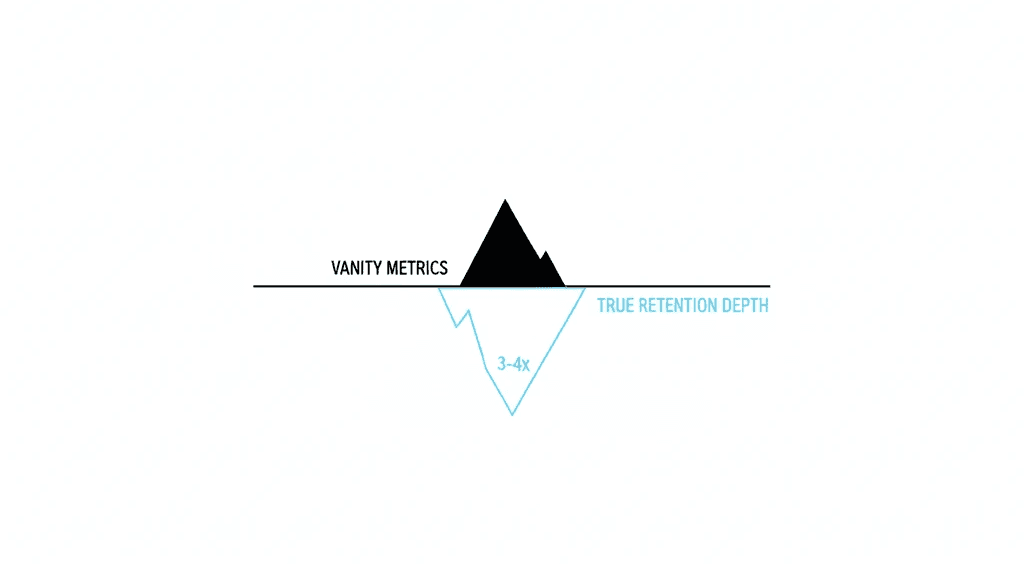
VCs spot this mistake immediately because they ask about cohort retention, and founders either have the analysis or they don't. If you don't have it, they know you haven't thought deeply about whether your product actually keeps users. You've been managing vanity metrics.
Mistake #2: Treating Retention as a Channel Problem
The second mistake flows from the first. Once a founder realizes their retention is weak, they often overcorrect into the wrong direction. They assume the problem is acquisition or onboarding. They think, "We need better users" or "Our onboarding is confusing."
So they rebuild the onboarding flow. They add an email nurture sequence. They create better App Store screenshots. They optimize the sign-up funnel to be three steps instead of five. Their Day 1 activation improves dramatically. Day 7 retention stays at 12 percent.
The founder is now certain the problem is product. Or market. Or timing. They start iterating on the core product features. They add new functionality. They launch a premium tier. Day 7 retention stays at 12 percent.
What they're missing is this: retention is primarily a product engagement problem, not an acquisition or onboarding problem. You can have perfect onboarding and zero retention. You can have broken onboarding and strong retention. Most founders assume that if onboarding is smooth, retention will follow. It doesn't work that way.
The correct approach is this. If your Day 1 retention is above 50 percent but Day 7 retention is below 15 percent, you have an engagement architecture problem. Your product works initially but doesn't give users a reason to come back. If your Day 1 retention is below 30 percent, you have an onboarding or product-market fit problem. Users aren't completing your core value prop.
VCs can identify this mistake by asking simple questions. "What is your Day 1 retention?" If it's 60 percent and Day 7 is 12 percent, they know the problem isn't onboarding. "What is your most engaged user segment? What do they do differently?" If you can't answer this, you haven't done cohort analysis. "What happens between Day 1 and Day 7? What could we look at to understand the drop?" If you're pointing to acquisition channel or onboarding as the explanation, you're missing the core issue.
The founders who don't make this mistake are the ones who can walk through their retention funnel like they walk through their city. They know where users drop off. They know which segments stick. They know which features correlate with retention. They've invested in understanding the problem before solving it.
Mistake #3: Designing Retention as an Afterthought
The third mistake is architectural. You design your core product. You get users. You realize retention is weak. Now you're trying to bolt engagement onto the product after the fact. You add notifications. You add progress bars. You add referral incentives. You add streaks and badges. Nothing moves the needle because retention isn't a feature you can add. It's how the product is fundamentally built.
When retention is designed from the start, it looks different. Your core onboarding brings users to a moment where they take a meaningful action—not just sign up, but take the action that actually creates value. Your core product loop is structured around triggers (why you'd come back), feedback (immediate evidence that your action worked), and variable reward (each session offers different, valuable context). Your notifications are engineered to arrive when users are most likely to find them valuable, not when you've decided to spam them.
Most importantly, your first week is engineered to activate habit formation. By Day 7, if your user hasn't internalized at least one reason to use your product regularly, they probably never will. That doesn't mean they need to be habit-forming like social media. If your product is utilities-based, your reason to return might be functional—you use it when you need to do something specific—but that functional loop should be established by Day 7. If it's not, the user is probably gone.
VCs spot this mistake by looking at your feature roadmap. Do you have six months of planned features to "improve retention"? That's a sign retention wasn't built in. Do you have engagement metrics from your current users, or are you planning to add those analytics later? Do you know what metric you're optimizing for (7-day retention, session frequency, DAU/MAU ratio), or are you optimizing for "growth"? If you don't have clear engagement metrics, you haven't built retention into your product. You're hoping it will emerge.
The founders who get this right are designing for behavior from Day 1. They're not asking "How many users can we get?" They're asking "What behavior do we need users to repeat, and how do we engineer that behavior into the experience?" That's a completely different product development process.
What VCs are Actually Looking For
When a VC reviews a pre-seed deal, retention metrics matter less than retention thinking. They're not expecting you to have Netflix-level engagement metrics at pre-seed. They're looking for evidence that you understand what retention means, that you've measured it properly, and that you're building it into your product deliberately.
Here's what they're asking themselves: Does this founder understand that retention is the core metric that determines whether they're building something real? Do they have data, or are they operating on narrative? Have they designed their product architecture around engagement, or are they treating engagement as something to add later?
If the answer to those three questions is yes, you'll get funding even if your current retention is weak. Because weak retention at pre-seed, with a founder who understands the problem and is actively solving it, is fixable. It's a product problem, and product problems can be solved.
If the answer is no—if you've confused retention with growth, if you're treating it as a channel problem, if you've bolted engagement onto a product that wasn't designed for it—then you're not fundable yet. Not because your idea is bad. Because you don't understand the core metric that will determine whether your idea survives.
The Three-Month Check-In
If you're building a product right now, test yourself against these three mistakes. Pull your retention cohorts. Can you see the drop-off pattern clearly? Are you tracking users from specific cohorts, or are you looking at aggregated metrics? Are you treating retention improvement as a product problem or an acquisition problem? Have you designed your core experience around engagement, or are you planning to "optimize for retention" after you get traction?
These aren't rhetorical questions. They're the questions your first VC will ask. The earlier you can answer them with evidence, the earlier you'll be fundable.
Can't diagnose your retention problem? Let's audit your cohort analysis and identify which of these three mistakes is blocking your funding. Book a free pre-seed retention assessment.
More articles
Explore more insights from our team to deepen your understanding of digital strategy and web development best practices.