Hooked in Saudi: How to Apply Nir Eyal's Hook Model to Fintech Apps

Tarik Al-Mansouri
Jan 16, 2024
Behavioral Psychologist & Cultural Strategist
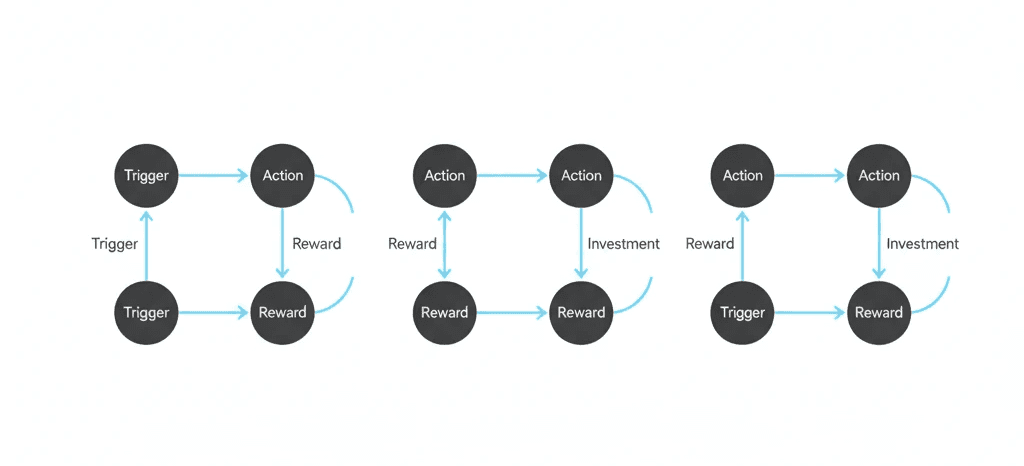
The Hook Model—trigger, action, reward, investment—sounds simple until you try to apply it to a fintech product in Saudi Arabia where user behavior is shaped by pay cycles, family financial dynamics, and religious practices that have no equivalent in Silicon Valley. Real application means more than copying a framework. It means understanding which hooks work in your specific market context, and which ones will trigger reactance instead of habit.
If you've read Nir Eyal's "Hooked," you've seen the framework. External trigger. Internal trigger. Action. Variable reward. Investment. Habit loop formed. The book is brilliant. The framework is powerful. But it was written with consumer apps and SaaS in mind, using examples from Instagram, Twitter, and Slack.
Now you're building a fintech app in Saudi Arabia or the broader GCC. The framework still applies. But the specific hooks that work look fundamentally different because the user's context, financial cycles, and decision-making processes are fundamentally different.
The problem most founders make is they learn the framework and then try to port it wholesale. They send push notifications at the same times global apps do. They expect daily engagement when their users are thinking in monthly financial cycles. They create social accountability around spending or saving with friends, not realizing that financial conversations in GCC markets are often private or family-only, not social.
When those hooks fail—when notification-driven engagement doesn't work or social features feel invasive—founders assume the framework doesn't apply. Actually, they've just applied it wrong for the market.
The Fintech Context: Why GCC Markets Are Different
Before you can apply the Hook Model effectively, you need to understand the triggers that already exist in your users' lives. In Western fintech markets, many of these are about optimizing abundance—earning more, investing smarter, automating savings. The triggers are frequent and varied because financial decisions happen throughout the month.
In GCC fintech, the primary triggers are often concentrated around pay cycles and religious/cultural events. Most salaried workers in Saudi Arabia, UAE, and broader GCC get paid on specific days. For many, the next primary financial trigger is Eid (after Ramadan spending, or for holiday preparation). For business owners and entrepreneurs, triggers might be tied to business cycles or quarterly tax periods. For families, triggers include collective financial decisions around travel, major purchases, or life events.
This doesn't mean users aren't thinking about money throughout the month. It means their financial actions are concentrated. They're not checking their investment app daily because they're not making investment decisions daily. They're checking their banking app because they need to pay a bill or monitor an account transfer. They're checking their insurance app when they need to file a claim or renew a policy.
The second context difference is that financial decision-making in GCC markets is often collective rather than individual. Multiple family members might have input on major purchases. Financial planning might involve discussion with parents, spouses, or business partners. This means the user experience can't always be designed around the individual optimizing their own finances. It needs to account for contexts where multiple people care about the same financial outcome.
The third difference is that trust is paramount. Users are more likely to engage with fintech products from established institutions or deeply trusted partners than from unknown startups. This doesn't mean you can't build user habits. It means the initial trigger to try your product is different. It's more likely to come through relationship (someone they trust recommended it) than through App Store discovery or marketing.
The Hook Model for Fintech in Saudi Arabia
Let's build a real example. Imagine you're building a micro-investing app targeting Saudi professionals. Your goal is to convert one-time investors into regular savers who invest monthly.
The external trigger is probably not a notification. If users haven't developed the habit yet, a push notification saying "Time to invest!" is friction, not help. Your external trigger is more likely the trigger that already exists. It's when users get paid. It's right before Ramadan. It's when they see a life milestone approaching. So your first activation might be event-based: "You've received your salary. Ready to invest your savings this month?" or "Ramadan is 6 weeks away. Families often plan for seasonal spending. Want to build a buffer?"
The action is removing friction from the behavior you want to reinforce. You want users to move money into an investment account. But moving money creates anxiety. So the action isn't "Open the app and transfer X amount." The action is something smaller. "Check your current balance. See your progress toward your Q4 goal." Once that's easy, the next action is "Move X amount into your investment bucket." You're breaking the behavior into smaller steps because in a market where financial trust is earned, moving money is a bigger decision.
The reward needs to be aligned with what your users actually value. In Western fintech, rewards are often about optimization—earn more, save more, beat the market. In GCC fintech for individuals, rewards are often about stability, family security, or achieving specific milestone goals. So your variable reward isn't "You're crushing your investment goal!" It's "You've now saved enough for your family's Hajj trip next year" or "You're 4 months away from your home down payment goal." The reward is progress toward something culturally meaningful, not abstract percentage gains.
The investment is what your users do to improve their experience with your app. It's the commitment that makes the next loop easier. In fintech, investment often comes through data. You tell the app about your financial goals. You set your investment preferences. You connect your bank account. The investment makes the next cycle easier. But in GCC markets, investment also includes trust-building. You've successfully invested. You got exactly the returns/stability you expected. You've built enough confidence to invest again. You've recommended the app to a family member and they've benefited. That social proof is investment.
Now the loop repeats. Every month when salary hits, the trigger fires. They open the app. The action is automatic (their regular monthly investment is ready to go). The reward is seeing progress toward their goal. The investment is reinforced—they've done this before, it worked, they trusted the process.
Localizing Each Element
The critical move is localization. Not translation, localization. Translation means rendering the English words in Arabic. Localization means understanding what each component of the hook needs to look like in your specific market.
External triggers in GCC fintech look different than global fintech. Don't use generic notification times. Use times that align with actual financial decision points. "Your bill is due in 3 days" is triggering. "Time to invest" is noise. "Your bonus has hit your account" is triggering. "Make your daily trades" is irrelevant if your users only make monthly moves.
The action should reduce friction and build trust. This might mean slower flows than global apps because financial decisions in conservative markets require more confidence. Show the user what will happen before it happens. Get explicit confirmation. Show successful outcomes from similar users (not with names, but with results). The action isn't efficient. It's confident.
The reward should connect to goals users actually care about. This requires research. You need to understand what financial outcomes matter most to your target segment. Is it retirement security? Family stability? Early access to property ownership? Ability to fund education? Once you know the goal, the reward is progress toward it, not abstract metrics.
The investment should build trust specifically. This might mean integration with traditional financial institutions. It might mean endorsements from community leaders. It might mean transparent reporting. It might mean connecting users with peers who've successfully used your app.
When the Hook Model Reveals What's Broken
One value of applying the Hook Model rigorously is that it reveals what you haven't thought through. If you can't identify a clear external trigger that prompts users to return, your retention will be weak. If your action requires significant friction or risk perception, your activation will be low. If your rewards aren't aligned with what users value, your habit formation will fail.
When you're building for GCC markets, this often reveals that the global framework is only partially applicable. A savings app designed for daily micro-interactions (common in the US) won't work in markets where financial transactions are monthly. A product designed around social accountability won't work in markets where financial conversations are private. A product that positions around investment returns won't resonate in markets where financial security and family stability are primary motivators.
This isn't a problem with the Hook Model. It's a requirement to apply the framework to your actual market, not an idealized version.
The Application Exercise
Take your fintech product. Map it against the Hook Model specifically for Saudi Arabia (or your target market).
External trigger: What event in your user's financial life prompts them to use your product? (Salary deposit, bill due, investment milestone, religious holiday prep?) What prompts them to return?
Action: What's the smallest action that moves them closer to your core value prop? What's the friction they experience? How do you reduce it?
Variable reward: What outcome matters to them? What progress can you show them? How does this cycle look different from the last one?
Investment: What data, decisions, or commitments have they made that make the next cycle easier?
If you can't answer each of these specifically for your market, you haven't localized the framework. You're still building for a generic version of fintech users. And generic fintech apps don't survive in markets as relationship-driven and culturally specific as the GCC.
Hook Model works for Western fintech but not your GCC users? Let's audit your engagement loops and identify which hooks need regional adaptation. Book a free fintech strategy session.
More articles
Explore more insights from our team to deepen your understanding of digital strategy and web development best practices.